
BELONG Learning Hub
Understanding students.
Building belonging.
Transforming learning.
Module 0: Why Berengarra School Exists
A BELONG® Model Learning Experience for the Berengarra School Community
Welcome
Welcome to the BELONG Model Learning Experience.
Every school has a purpose. Every educational model begins with a belief about how young people learn, grow and succeed.
Before exploring the Berengarra BELONG Model, we'll begin by discovering why Berengarra School exists. Understanding our purpose helps us make consistent decisions, build meaningful relationships, and create an environment where every student has the opportunity to belong, engage and thrive.
In this module you'll discover...
- Why Berengarra School exists.
- The educational gap Berengarra School was created to address.
- What makes Berengarra School different from other educational settings.
- Understand why student fit matters.
Approximately how many years has Berengarra School been in operation?
50 Years of Learning
Berengarra School has been supporting young people for 50 years.
Over that time, the school has continued to respond to a clear educational need: some capable young people require a smaller, more relational and wellbeing-focused environment in order to access learning successfully.
Berengarra School's purpose has grown from this experience. The school's approach has been shaped by decades of learning from students, families and staff about what helps young people feel safe, connected and ready to learn.
- Students thrive when they feel safe and known.
- Relationships come before meaningful learning.
- Wellbeing and learning cannot be separated.
- One school model does not fit every student.
- High expectations and individualised support can work together.
- Every young person deserves a place where they can belong.
The BELONG Model brings these lessons together into a shared framework for how Berengarra School supports students today.
Every School Has a Purpose
Traditional secondary schools work well for many young people. They provide structure, curriculum, friendships, routines and pathways that help students learn and grow.
But no single school environment works for every student. Some capable young people find it difficult to access learning when the environment feels too large, too fast, too socially demanding or not relational enough.
Berengarra School exists in response to this educational gap.
Mini Game: What Was Missing?
Berengarra School exists because...
"...breaks down traditional barriers to education, supports inclusive learning, and treats each student as a unique individual."
Berengarra School exists because removing barriers to learning is just as important as delivering the curriculum.
What Makes Berengarra School Different?
Berengarra School is first and foremost a secondary school. What makes Berengarra School different is how education is delivered.
Click each card to discover why each feature matters.
"A Learning Community where all members engage in structured and purposeful activities, offering students' academic growth alongside embedded social and emotional learning."
Berengarra School delivers a genuine secondary education where academic learning and wellbeing work together rather than in isolation.
Check Your Understanding
Decide whether each statement is a Fact or a Myth.
1. Berengarra School is a youth re-engagement program.
2. Berengarra School teaches the Victorian Curriculum.
3. Berengarra School exists because some capable students need a different learning environment to thrive.
4. Berengarra School was created because mainstream schools fail students.
Why Student Fit Matters
Not every school is the right fit for every student. Likewise, Berengarra School is not designed to meet every educational need.
Student-school fit asks a better question than “Can this student enrol?”
It asks: Is this a student who is likely to thrive within our educational model?
"Building Relationships supports students' sense of being known, respected and included, creating safety, connection and belonging; prerequisites to learning."
Why this matters
Student fit isn't about labels or diagnoses. It's about whether Berengarra School is the right environment to create these conditions for that student.
Mini Game: Best Fit, Different Fit
Choose the best category for each student need.
Reflection
If Berengarra School did not exist, where might the students we serve go? What might they miss out on?
How does understanding Berengarra School's purpose shape the way you approach your role?
Knowledge Check
Answer all five questions, then select 'Check score'.
Congratulations
You have completed Module 0: Why Berengarra School Exists.
Key message: For 50 years, Berengarra School has responded to the needs of capable young people who require a smaller, more relational and wellbeing-focused secondary school environment to thrive.
The Berengarra BELONG Model is the framework that brings this purpose to life.
Module 1: Understanding Student Fit
A BELONG® Model Learning Experience for the Berengarra School Community
Welcome
The BELONG Model is founded on principles that can strengthen many learning, workplace and care environments.
At Berengarra School, these principles have been intentionally adapted to support a specific group of students. Understanding student fit helps ensure the model is being used in the environment it was designed for.
Learning Outcomes
- Explain what student fit means at Berengarra School.
- Identify characteristics of students who are likely to thrive.
- Understand why fit is about educational needs, not labels.
- Recognise when another setting may be more appropriate.
- Connect student fit to the BELONG Model.
What is Student Fit?
Student fit is not about diagnosis, labels or a single assessment score. It is about whether Berengarra School's learning environment is the right environment for a student to experience belonging, engagement, learning and growth.
A strong fit means the student can learn, participate safely, build relationships and grow with support in a small secondary school environment.
Find the Right Fit
You are Mason, the Enrolments Manager.
Every enquiry begins with the same question: Could Berengarra School genuinely provide the environment and level of support this student needs to thrive?
Read each enrolment file. First, make an enrolment decision. Then choose the one BELONG principle that most directly supports your reasoning. Several BELONG principles may be relevant. Select the principle that provides the strongest reason for your decision. After making both selections, choose Reveal Mason’s notes to compare your thinking.
📁 Enrolment File 01: Sophie, Year 8
- Bright and curious learner.
- Has attended three secondary schools.
- Finds large classes overwhelming.
- Takes time to trust adults.
- Participates well once settled.
- Responds well to routine and explicit teaching.
Your enrolment decision
Which BELONG principle best supports your decision?
Mason's Decision: Likely to thrive at Berengarra School.
Sophie's learning capacity is evident. Her greatest barrier is developing trust with adults and feeling emotionally safe enough to engage consistently.
Best BELONG principle: Building Relationships. Sophie’s profile suggests that her access to learning depends first on trust, consistency and emotional safety. Engagement and Learning Community are also important, but they are more likely to follow once the relational conditions are in place.
📁 Enrolment File 02: Noah, Year 9
- Cognitive assessment indicates intellectual functioning below the average range.
- Requires additional processing time.
- Benefits from repeated instructions and visual supports.
- Participates safely throughout the school day.
- Builds positive relationships with adults.
- Enjoys practical learning experiences.
Your enrolment decision
Which BELONG principle best supports your decision?
Mason's Decision: More information needed.
Noah shows several positive indicators of fit. However, further information is needed to understand the level and frequency of learning support he requires. Berengarra has an approximate 1:6 staff-to-student ratio, which allows for significant support within small classes. However, the school cannot provide ongoing, dedicated 1:1 assistance throughout the school day. The key question is therefore whether Noah can participate in the learning program with the adjustments and shared classroom support Berengarra School can reasonably provide, or whether he requires continuous individual assistance. If Noah can access learning through additional processing time, repetition, visual supports, explicit teaching and small-group assistance, he may be a good fit. If he requires ongoing 1:1 support to participate safely or access the curriculum, another educational setting may be better able to meet his needs
Best BELONG principle: Learning Community This principle focuses on creating structured, purposeful and accessible learning through explicit teaching, targeted planning and appropriate support. Noah participates safely, builds positive relationships with adults and enjoys practical learning. His profile suggests that he may benefit from a smaller learning environment that can provide additional processing time, repeated instructions, visual supports and hands-on learning experiences..
📁 Enrolment File 03: Emily, Year 10
- Cognitive assessment indicates intellectual functioning below the average range.
- Has significant difficulty understanding everyday expectations.
- Becomes highly distressed when routines change.
- Frequently leaves supervised learning areas.
- Requires continuous adult support to remain safe.
- Learning goals are centred primarily on life skills and personal care.
Your enrolment decision
Which BELONG principle best supports your decision?
Mason's Decision: Another educational setting may currently be more appropriate.
The key issue is not her cognitive assessment alone. It is the level and type of support she requires:
- Continuous adult supervision to remain safe.
- Significant difficulty understanding everyday expectations.
- High distress when routines change.
- Frequently leaving supervised areas.
- Learning goals focused mainly on life skills and personal care.
Berengarra’s approximate 1:6 staff-to-student ratio provides substantial support within small classes, but it cannot provide ongoing dedicated 1:1 supervision or a program centred primarily on personal care and intensive life-skills support.
When Berengarra School is not the best fit, Mason uses theUse the School Finder on the Berengarra School website to help families explore schools whose educational models better match their child's needs.
Best BELONG principle:
If you selected “Another educational setting may be more appropriate”
You do not need to choose a BELONG principle.
Instead, identify the support need that may be outside Berengarra’s scope, such as:
- Ongoing dedicated 1:1 assistance.
- A secure behaviour program.
- Intensive specialist disability support.
- A level of clinical or therapeutic care that cannot be provided within the school environment.
📁 Enrolment File 04: Jayden, Year 8
- Wants to attend school.
- Teachers report that Jayden has positive relationships with adults.
- During periods of stress, has tipped furniture, damaged classroom property and intimidated nearby students.
- Staff report these incidents are increasing in frequency.
- Other students are regularly removed from the area while staff restore safety.
Your enrolment decision
Which BELONG principle best supports your decision?
Mason's Decision: More information needed.
Jayden wants to attend school and his teachers report that he has positive relationships with adults. The unsafe incidents are serious and increasing, but the available information does not explain what is triggering them. Further assessment is needed to understand whether the behaviour is linked to features of his current mainstream environment, such as noise, crowds, smells, rapid transitions or other sources of overload. Berengarra’s smaller setting, lower staff-to-student ratio and more relational approach may reduce some of these stressors and allow staff to respond earlier and more individually.
Best BELONG principle: Overcoming Challenges This principle focuses on understanding setbacks and distress through curiosity, preserving dignity, maintaining connection and providing the support needed to work through difficulty. The key question is whether Jayden can remain safe and engaged with the supports Berengarra can provide, or whether he requires a more intensive behaviour support environment.
📁 Enrolment File 05: Chloe, Year 11
- Strong academic ability.
- Attendance below 40%.
- Significant anxiety before school.
- Participates well once she arrives.
- Wants to complete VCE VM before moving into TAFE.
Your enrolment decision
Which BELONG principle best supports your decision?
Mason's Decision: Likely to thrive at Berengarra School.
The student has strong academic ability, wants to complete VCE Vocational Major and has a clear pathway goal of moving into TAFE. Although attendance is currently below 40%, she participates well once she arrives at school. This suggests that her low attendance may be connected to anxiety and difficulty accessing her current school environment, rather than a lack of interest in learning. Berengarra’s smaller, more relational and wellbeing-focused environment may reduce the barriers that occur before school and help her participate more consistently.
Best BELONG principle: Engagement. Engagement focuses on creating the conditions that allow a student to participate meaningfully in learning. This includes trusted relationships, relevant learning, personal interests, strengths-based support and authentic participation. Her strong academic ability, successful participation once at school and clear VCE VM and TAFE goals indicate that she is motivated to learn. The key question is whether Berengarra’s environment can help translate that motivation into more consistent attendance and sustained engagement. Building Relationships and Navigate are also relevant. Trusted relationships may help reduce anxiety, while Navigate connects with her future pathway goals. However, Engagement most directly explains the current fit question because her main barrier is accessing and participating in school consistently.
Student Fit and the BELONG Model
Student fit matters because the BELONG Model works best when the student's needs align with the environment Berengarra School provides.
At Berengarra School, the BELONG Model supports students through relationships, engagement, learning community, challenge, navigation and growth.
The question is not simply, "Can this student enrol?"
The stronger question is, "Is this student likely to thrive within Berengarra School's educational model?"
Reflection
Think of a student who was, or may have been, a strong fit for Berengarra School.
What helped them access learning, build relationships and experience success?
Knowledge Check
Choose the best answer for each question. Your score updates automatically.
Key Takeaway
Berengarra School is a secondary school for students who can learn, participate safely, build relationships and grow when supported through a small, relational, wellbeing-first environment.
Student fit is not about asking whether a student is easy to support. It is about asking whether Berengarra School is the right educational environment for that student.
Module Complete
Congratulations! You have completed Module 1: Understanding Student Fit.
Next module: What is the BELONG Model?.
Module 2: What Is the BELONG Model?
A shared framework for how Berengarra School supports students, staff, families and community.
Welcome
Modules 0 and 1 explored why Berengarra School exists and who the school is designed to support.
This module introduces the BELONG Model itself: what it is, why Berengarra developed it and how it guides decisions across the school.
Learning Outcomes
By the end of this module, you will be able to:
- explain what the BELONG Model is and why Berengarra developed it
- identify the six BELONG elements
- describe how the elements connect
- explain why BELONG is not a linear checklist
- recognise how BELONG applies to students, staff, families and community
- distinguish BELONG from a behaviour program, wellbeing program or teaching strategy
- apply BELONG thinking to an everyday school decision
Why Berengarra Developed the BELONG Model
Berengarra School has spent decades learning from students, families and staff about what helps capable young people access education successfully.
That experience showed that learning cannot be separated from safety, relationships, participation, challenge, agency and future direction.
What Is the BELONG Model?
The BELONG Model is Berengarra School's whole-school framework for supporting participation, learning, agency and growth.
It explains the conditions the school seeks to create and the responsibilities shared across the school community.
It helps staff consider not only what a student is doing, but what conditions may help that student feel safe, participate meaningfully and move forward.
- whole-school
- relational
- developmental
- individualised
- evidence-informed
- connected to learning and future pathways
Activity: What Best Describes BELONG?
Choose the description that best fits the BELONG Model.
Which description best fits the BELONG Model?
Who Does BELONG Apply To?
BELONG is not a student-only model. Each element also shapes how staff work together, how families experience the school and how Berengarra connects with the wider community.
Students
Experience safety, participation, belonging, support through challenge, agency and growth.
Staff
Build trust, collaborate, reflect, use professional judgement and develop shared practice.
Families
Are informed, heard, included and supported to understand needs, choices and pathways.
Community
Contributes to learning, pathways, inclusion and opportunities beyond the school.
The Six BELONG Elements
Select each card to reveal its role within the model.
How the Elements Connect
The six elements are connected rather than linear. Depending on what is happening for the student, a different element may need to come forward at any time.
BELONG Is Not a Linear Checklist
BELONG is developmental, but it is not a sequence that students complete once and leave behind.
Students may move between elements depending on the situation, relationship, environment or stage of learning.
The question is: “Which elements are most relevant to what is happening now?”
What the BELONG Model Is Not
BELONG may influence behaviour support, wellbeing and teaching, but it is broader than any one of these.
Not a behaviour program
BELONG does not reduce students to behaviour or prescribe one response for every situation. It helps staff consider the conditions, relationships and supports surrounding what is happening.
Not a wellbeing add-on
Wellbeing is not treated as separate from learning. The BELONG Model connects safety and wellbeing with participation, responsibility, learning and future pathways.
Not a teaching strategy
BELONG informs teaching practice, but it also shapes relationships, staff culture, family partnership, enrolment decisions and whole-school responses.
Using the BELONG Model in Everyday Decisions
BELONG helps staff move beyond reacting only to the behaviour in front of them.
A student arrives late, refuses the planned task and sits apart from the group. They quietly tell a trusted staff member that the morning was difficult.
Which response best reflects BELONG thinking?
Reflection
Knowledge Check
Module Complete
You have completed Module 2: What Is the BELONG Model?
BELONG is Berengarra's shared whole-school framework. Its six connected elements help staff consider the conditions people need to feel safe, participate, learn, work through challenge, build agency and grow.
Module 3: Building Relationships
A BELONG® Model Learning Experience for the Berengarra School Community
Welcome
Module 3 is where the BELONG Model begins in practice. Now that we have explored who Berengarra School is designed to support, this module looks at how relationships create the foundation for learning, safety and growth.
Learning Outcomes
By the end of this module, you will be able to:
- Explain why relationships create the conditions for learning.
- Recognise how safety, stress and relational responses affect readiness to learn.
- Identify behaviours that build or weaken trust.
- Apply co-regulation and relationship-repair strategies.
- Maintain boundaries and high expectations relationally.
- Recognise your own responsibility as a relationship builder.
The Berengarra BELONG Model
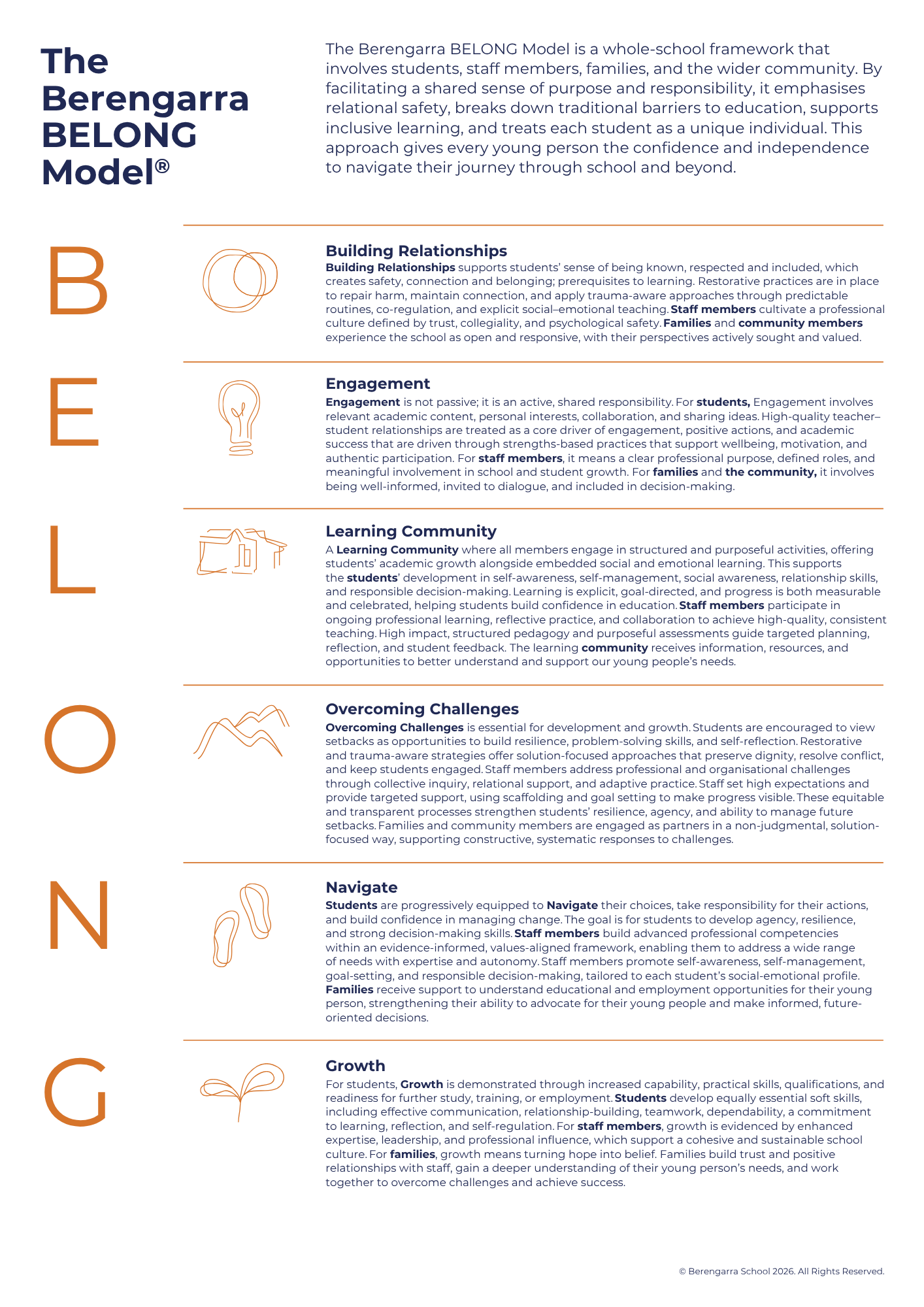
Relationships Create the Conditions for Learning
Learning requires more than presenting information or setting a task. Students also need to feel safe enough to pay attention, ask questions, make mistakes and accept support.
For many Berengarra students, previous experiences of school may have taught them to expect judgement, rejection, conflict or failure. Before they can fully engage with learning, they may need repeated experiences that show them something different.
- You are welcome here.
- I will treat you with respect.
- You do not have to get everything right.
- A difficult moment does not mean you have lost the relationship.
- I will support you while maintaining clear expectations.
This does not mean a student must have a close personal relationship with every staff member before learning can occur. It means students need to experience adults as safe, reliable and fair.
What relationships make possible
When a student feels known and respected, they are more likely to:
- Enter the classroom and remain present.
- Attempt work that feels difficult.
- Ask for clarification or support.
- Accept feedback without feeling personally attacked.
- Recover after frustration or conflict.
- Take appropriate learning and social risks.
Why Relationships Create the Conditions for Learning
Students are more able to learn when they feel safe enough to make mistakes, accept help and remain connected during difficulty. A trusted adult can reduce uncertainty, help a student regulate and make challenging learning feel more manageable.
Relationships do not replace expectations. They create a pathway for students to meet them.
Scenario 1: The Unfinished Task
Sam has been asked to begin a written task. After several minutes, the page is still blank.
When a staff member approaches, Sam pushes the worksheet away and says:
The staff member knows that Sam sometimes avoids tasks when they are worried about getting the answer wrong.
Explore both responses. What might each response communicate to Sam?
Response 1
"You haven't even tried. Everyone else has started, so you need to get on with it."
Response 2
"It looks like getting started feels hard today. Let's look at the first question together, then you can choose whether to write or tell me your answer."
Scenario 2: The Student Who Arrives Late
Taylor arrives halfway through the lesson, avoids eye contact and sits at the back of the room.
Response 1
"You're late again. Why can't you get here on time?"
Response 2
"I'm glad you made it in. Take a minute to settle, then I'll show you where we're up to."
Scenario 3: The Student Who Rejects Help
A staff member offers support with a maths task. Riley responds:
Response 1
"Fine. Don't ask me when you get it wrong."
Response 2
"No problem. I'll give you some space. I'll check back in a few minutes in case you want a hand."
Scenario 4: The Student Who Makes a Mistake
Morgan gives an incorrect answer during a group discussion. Another student laughs, and Morgan becomes quiet.
Response 1
"You need to pay more attention before answering."
Response 2
"Thanks for having a go. That answer helps us think about the question. Let's work through the next step together."
Scenario 5: Sarcasm During a Difficult Moment
Jordan has been talking over the teacher and making repeated off-topic comments.
Response 1
"Thanks, Jordan. I'm sure everyone was just waiting for another one of your helpful comments."
Response 2
"Jordan, I'm going to pause this conversation now. I need you to listen while I finish the instructions. We can come back to what you want to say afterwards."
"I was frustrated earlier and used sarcasm. That wasn't respectful or helpful. I still needed you to stop interrupting, but I should have handled it differently."
Safety, Stress and Readiness to Learn
When students feel unsafe, overwhelmed or on alert, their brain is often focused on protection rather than learning. Calm and predictable relationships help students feel safer, regulate, connect and re-engage.
This does not mean removing expectations. It means creating the conditions in which the student is more able to meet them.
Learning Activity
When students feel unsafe, overwhelmed or highly alert, their attention may be directed towards managing stress rather than participating in learning.
Behaviour can provide clues about a student's current level of readiness and engagement. Look for clusters of signs, changes from the student's usual presentation and the surrounding context.
Read each student profile carefully. Notice their body language, facial expression, voice, movement and capacity to enter, remain present and participate.
Sort The Student Profiles
Choose the best category
Engaged and ready to participate
The student appears settled enough to enter, communicate, organise themselves and respond to ordinary learning demands.
Engagement may need support
The student is moving towards participation but may need a calm check-in, additional structure, reduced language or help with the first step.
Stress may be reducing engagement
The student is showing several signs of stress that may be limiting their ability to enter, remain present, communicate or participate in learning.
Student profiles to sort
✓What should staff notice?
A single behaviour does not tell us exactly what a student is feeling.
Look for:
- clusters of signs
- changes from the student's usual presentation
- body tension, movement and breathing
- facial expression and environmental scanning
- changes in voice, language or communication
- ability to enter and remain present
- ability to organise, begin and continue a task
- whether the student's stress reduces or increases in response to support
Stress can affect whether a student can enter, remain present, communicate, accept support and participate in learning.
A relational response does not remove expectations. It helps create the conditions in which the student is more able to meet them.
Game 1: What Builds Trust?
Trust is built through repeated experiences of adults being safe, reliable, respectful and fair.
Select each card to turn it over and explore whether the behaviour builds or weakens trust. You must turn every card before continuing.
Module Complete
You have completed Module 3: Building Relationships.
Next module: Engagement.