
Schools Directory
Helping families find the right fit
Berengarra School is a non-denominational, co-educational specialist secondary school for Years 7–12. Since 1977, we have supported young people whose learning has been affected by social and emotional complexities, including anxiety, trauma, neurodivergence and difficulties engaging with mainstream education.
We also know that no single school is right for every young person. We created this directory to help families, carers and professionals understand the different options available and find settings worth exploring.
Every young person deserves a school where they feel safe, understood and able to learn. Berengarra may be the right fit for some families, but our broader hope is that this directory helps more young people find the setting that works for them.
Explore School Options
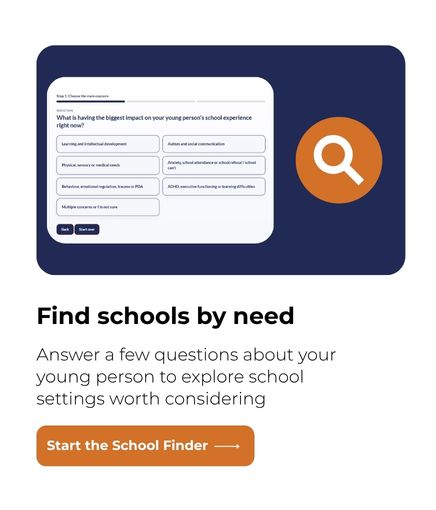
Answer a few questions about your young person’s learning, wellbeing and support needs to explore Victorian schools and school settings that may be worth considering.
Help us improve the School Finder
Did you find useful school options, or did we miss something?
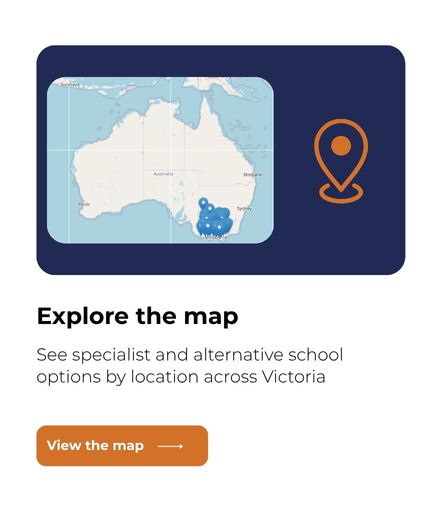
Use the map to explore specialist and alternative schools across Melbourne and regional Victoria, including Special Assistance Schools, specialist schools and flexible learning settings.
- View schools across government, Catholic and independent sectors
- Identify options near your location
- Explore different specialist and alternative school settings
Compare School Types
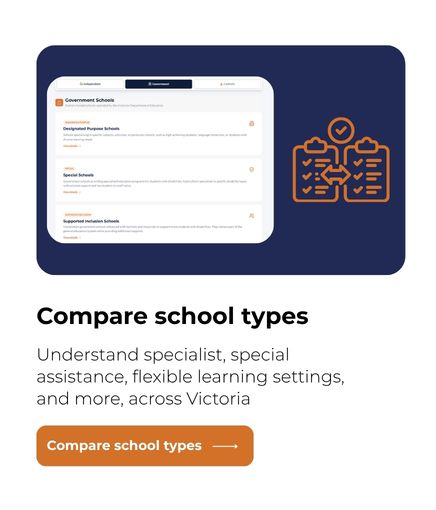
Find the right school setting for your child across Independent, Government and Catholic sectors.
Finding the right school setting can be difficult when a young person needs additional support with learning, wellbeing, disability, emotional regulation, behaviour or school attendance. This guide compares school options across Victoria’s independent, government and Catholic education sectors.
Use the comparison to understand:
- • Who each school setting is designed to support
- • Eligibility and enrolment requirements
- • The learning, wellbeing and disability needs supported
- • Key features, services and pathways
Every young person is different. Use this guide as a starting point, then contact individual schools to discuss your young person’s needs and confirm suitability.
Independent Schools
Non‑government schools with distinct missions, governance structures, and registration with the Victorian Registration and Qualifications Authority (VRQA).
📌 Important: How students are grouped
Students are not grouped just by diagnosis. They are supported based on:
- • Functional impact — how the condition affects learning and daily activities
- • Level of adjustment required — substantial or extensive support needs
Independent Special Assistance Schools
Serve young people disengaged from education whose needs aren’t met by mainstream schools or education services. These schools provide alternative settings for students with high-level social and emotional needs, behavioural difficulties, or who benefit from flexible learning structures.
Independent Special Schools
Non-government schools offering specialised education for students with specific needs, disabilities, or learning differences. These schools provide tailored curricula and targeted support within an independent school framework.
Frequently asked questions
Learn more about Victoria’s school options, student support needs, eligibility and finding the right setting.
Finding the right school
What school options are available in Victoria for young people who need additional support?
Victoria has a range of settings across the government, Catholic and independent education sectors. Depending on a young person’s needs, options may include:
- Mainstream schools with adjustments and additional support
- Supported inclusion schools
- Government, Catholic and independent specialist schools
- Independent Special Assistance Schools
- Flexible learning and education re-engagement programs
What is a Special Assistance School?
A Special Assistance School is an independent school for young people who are disengaged, or at risk of disengaging, from education and whose needs have not been adequately met in other settings.
These schools generally offer smaller and more flexible learning environments, individualised support, strong relationships with staff and an emphasis on wellbeing and re-engagement. Programs and enrolment criteria vary between schools.
How can I find alternative or specialist schools near me?
You can use this directory to:
- Compare different school types
- Explore schools by location
- Search according to learning, wellbeing and support needs
- Identify schools to contact for further information
The School Finder provides a starting point. Always contact individual schools to confirm their current programs, availability and enrolment criteria.
Learning, wellbeing and attendance
What school options may support school attendance difficulties?
Young people experiencing school attendance difficulties, sometimes described as school refusal or school can’t, may benefit from settings that offer:
- Smaller and more predictable learning environments
- Strong relationships with consistent staff
- Individualised attendance and re-engagement planning
- Wellbeing and regulation support
- Flexible approaches to learning
Possible options include Special Assistance Schools, flexible learning programs and some specialist or mainstream schools with appropriate supports.
What should I look for when a young person experiences anxiety, trauma or emotional regulation difficulties?
Useful features may include:
- A calm, predictable environment
- Trauma-informed and neurodiversity-affirming practice
- Small classes or reduced transitions
- Access to wellbeing and counselling support
- Staff who understand regulation and relationship-based practice
- Flexible, individualised approaches to learning
Ask schools how these supports work in everyday practice, not just whether they are available.
Are there schools for autistic students or students with ADHD who struggle in mainstream settings?
Yes. Depending on the student’s learning profile and support needs, options may include mainstream schools with adjustments, supported inclusion schools, specialist schools, Special Assistance Schools and other alternative settings.
A diagnosis alone does not determine the right school. Consider how the student’s needs affect learning, communication, regulation, attendance, relationships and participation throughout the day.
Berengarra School
Who may Berengarra School be suitable for?
Berengarra is a specialist secondary school for students in Years 7–12 whose learning and engagement have been affected by social and emotional complexities.
It may suit young people who:
- Are finding it difficult to engage or feel safe in a mainstream setting
- Experience anxiety, trauma, emotional distress or school attendance difficulties
- Are autistic, have ADHD or have other neurodivergent learning profiles
- Benefit from smaller classes, consistent relationships and individualised support
- Can participate in learning without continuous one-to-one support
Suitability is considered individually through Berengarra’s enquiry and enrolment process.
How does Berengarra support students?
- Small classes and a high level of staff support
- Individualised, skills-based learning
- Consistent routines and supportive relationships
- Trauma-informed and neurodiversity-affirming practice
- On-site counselling at each campus
- Flexible pathways connecting wellbeing, engagement and learning
Eligibility and pathways
Does a student need a diagnosis to attend a specialist school?
It depends on the school type.
Some specialist schools have formal disability, cognitive, adaptive behaviour or language eligibility requirements. Other settings may focus more on educational disengagement, functional needs and the level of support required.
Contact individual schools to confirm their current criteria and any assessments or documentation needed.
Can students move back to mainstream education?
Some students transition to mainstream education after rebuilding confidence, engagement and learning skills. Others remain in a specialist or alternative setting, or move into a different senior secondary, vocational or supported pathway.
Returning to mainstream school is not always the goal. The aim is to find a sustainable educational pathway that meets the young person’s needs.
How do I decide which school setting to explore?
Consider:
- What is making learning or attendance difficult
- The environment in which the young person feels safest
- The level and type of adjustment required throughout the day
- Class size, routines, transitions and staff consistency
- Curriculum, qualifications and future pathways
- Eligibility, availability, location and cost
Visiting schools and asking how support works in practice can be more useful than relying on labels alone.
Does appearing in this directory mean Berengarra recommends a school?
No. The directory is designed to help families, carers and professionals identify options to investigate. It is not an endorsement, guarantee of suitability or confirmation that a student meets a school’s enrolment criteria.
Programs, availability and eligibility requirements can change, so contact schools directly before making decisions.
Important Information
ℹ️ General Guidance This School Finder provides general guidance only. Results may vary depending on individual circumstances, availability, and enrolment criteria.
💬 Professional Advice This tool does not replace professional advice. We recommend contacting schools directly to confirm suitability.
⚠️ Accuracy and Availability While we aim to keep information accurate and current, completeness and availability cannot be guaranteed.
Data Source
© Copyright State Government of Victoria.
School location data sourced from the Victorian Government open data portal (CC BY 4.0).
Last updated: 23 September, 2026